• Skip to primary navigation
  • Skip to main content
  • Skip to footer
Rising Star Real Estate
Florida Real Estate Experts
(850) 613-6832 | Login / Register
  • Search
    • Search All Listings
    • Office Listings
    • Waterfront Properties
    • Foreclosures & Short Sales
    • Hot Sheet
    • Email Alerts
    • Market Reports
  • Neighborhoods
  • About
    • About Us
    • Testimonials
  • Blog
  • Contact
  • Search
    • Search All Listings
    • Office Listings
    • Waterfront Properties
    • Foreclosures & Short Sales
    • Hot Sheet
    • Email Alerts
    • Market Reports
  • Neighborhoods
  • Buyers
    • Why Use a Realtor?
    • Getting Pre-Approved
    • Closing Costs Explained
    • Property Taxes
    • Renting? 4 Quick Ways to Buy a Home with Little or NO Money Down
  • Sellers
    • What’s My Home Worth
    • What’s the Right Price for my Home?
    • Top Questions to Ask a Real Estate Agent
    • Preparing Your Home to Sell
  • About
    • About Us
    • Our Agents
  • Contact
Home > Archives for November 2024

Archives for November 2024

The vast majority of Americans celebrate Thanksgiving, but their traditions and activities vary widely

BYJOHN GRAMLICH, MICHAEL ROTOLOANDLAURA SILVER
(From left: Frederic J. Brown/AFP; Gilbert Carrasquillo/GC Images; MediaNews Group/Long Beach Press-Telegram, all via Getty Images)

Just a few weeks after a divisive presidential election, millions of Americans will break bread together for Thanksgiving. A new Pew Research Center survey shows how Americans plan to spend the holiday this year – and which Turkey Day traditions and activities are more common than others.Here are the main takeaways from the survey, conducted Nov. 12-17, 2024, among 9,609 U.S. adults:

Around nine-in-ten Americans (91%) celebrate Thanksgiving. Large majorities in all major demographic groups observe the holiday, though some people are more likely than others to do so. For example, 96% of Americans ages 65 and older celebrate Thanksgiving, compared with somewhat smaller shares of younger adults.

Immigration status also plays a role. While 93% of adults born in the United States celebrate Thanksgiving, the same is true of 88% of immigrants who have been in the country for more than 20 years, 76% of immigrants who have been in the country 11 to 20 years, and 74% of immigrants who have been in the country for a decade or less.

Most Americans (74%) plan to have Thanksgiving dinner with other people this year. Another 5% plan to have Thanksgiving dinner alone, 2% don’t plan to have Thanksgiving dinner – whether it’s because they are working or traveling or for some other reason – and 10% didn’t know their plans yet at the time of the survey. The rest don’t celebrate Thanksgiving.

For some Americans, Thanksgiving dinner includes lots of other people. Around a quarter (26%) expect to have Thanksgiving dinner with more than 10 other people this year, including 7% who expect to have it with more than 20 others.

Smaller get-togethers are more common: 26% of Americans plan to have dinner with six to 10 other people, 15% with three to five other people, and 4% with one to two other people. The remaining Americans plan to have Thanksgiving dinner alone, don’t plan to have Thanksgiving dinner, didn’t know their plans yet or don’t celebrate Thanksgiving.
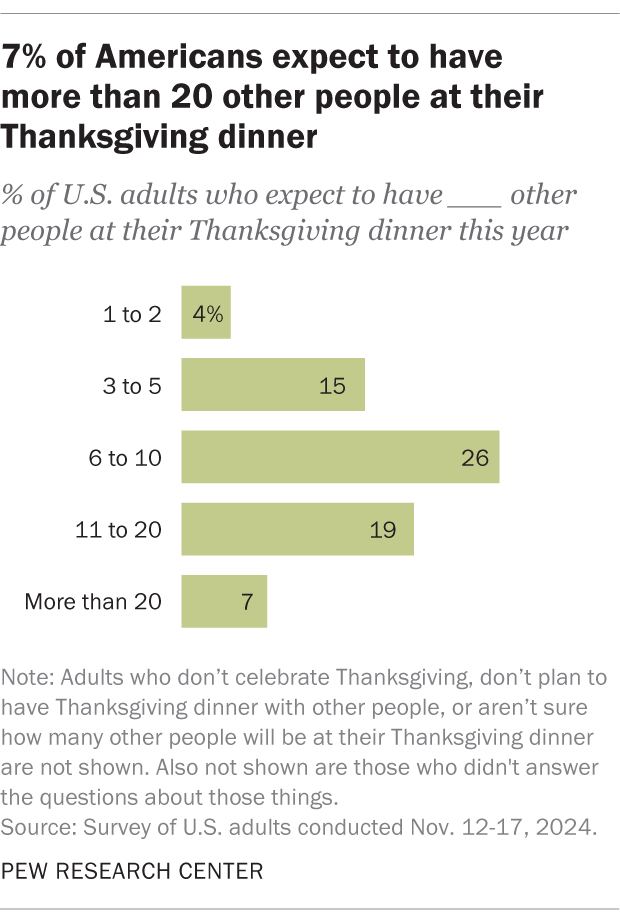
A bar chart showing that 7% of Americans expect to have more than 20 other people at their Thanksgiving dinner.

Around a third of Americans (34%) plan to have Thanksgiving dinner at their own home this year, whether hosting others or dining alone. Another 39% plan to go to someone else’s home, while 3% plan to go to a restaurant, hotel or other public place. The rest plan not to have Thanksgiving dinner, didn’t know their plans yet or don’t celebrate the holiday.

Older adults are more likely than younger people to have Thanksgiving dinner at their own home: 40% of Americans ages 50 and older plan to do so this year, compared with 29% of adults under 50.

Afternoon is the most popular time for Thanksgiving dinner, but there’s no consensus on early versus late afternoon. Some 36% of Americans prefer to have Thanksgiving dinner in the early afternoon (that is, between noon and 3 p.m.), while 38% prefer to have it in the late afternoon (between 3 and 6 p.m.). Only 11% of Americans prefer to have Thanksgiving dinner in the evening (after 6), and just 1% prefer to have it in the morning (before noon). Another 5% have no preference.

Dinnertime preferences follow a regional pattern. Americans who live in the Midwest and South are more likely to prefer Thanksgiving dinner in the early afternoon than the late afternoon. But people in the Northeast and West are more likely to prefer the late afternoon than the early afternoon.

There are also differences by age. Americans 65 and older are more likely to prefer Thanksgiving dinner earlier in the afternoon than later. Meanwhile, adults under 30 are more likely to prefer late afternoon over early afternoon.
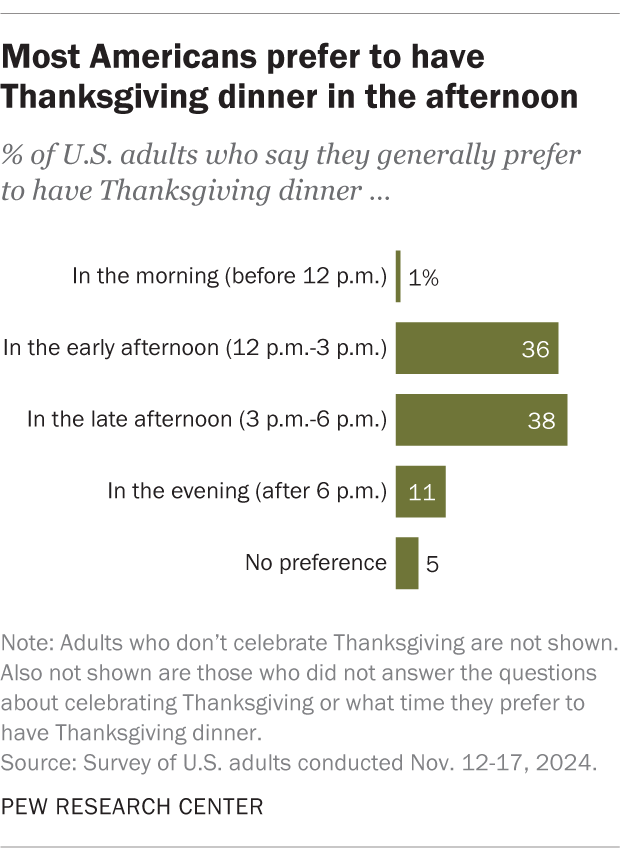
A bar chart showing that most Americans prefer to have Thanksgiving dinner in the afternoon.
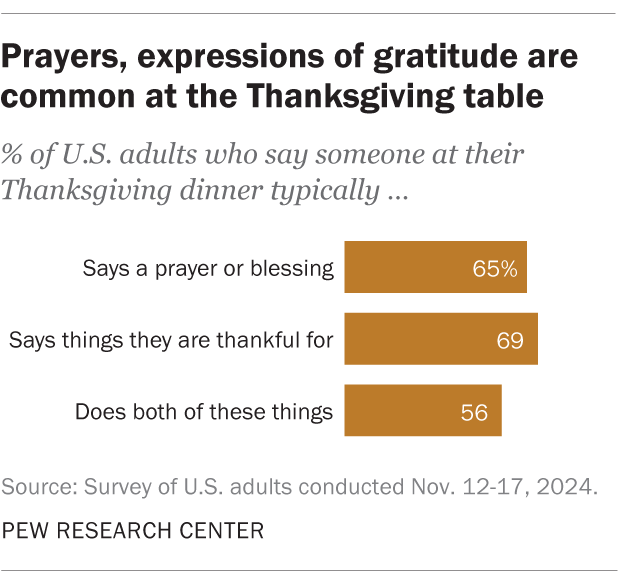
It’s common for Americans to say grace or express gratitude at Thanksgiving dinner. Around two-thirds of U.S. adults say someone at their dinner typically says a prayer or blessing (65%) or says things they are thankful for (69%). And a majority of Americans (56%) say someone at their Thanksgiving dinner typically does both of these things.
A bar chart showing that prayers and expressions of gratitude are common at the Thanksgiving table.

Saying grace at Thanksgiving is especially common among certain religious groups. For example, 91% of White evangelical Protestants say someone at their Thanksgiving dinner typically says a prayer or blessing. The same is true for 88% of Black Protestants, 74% of Catholics and 72% of White nonevangelical Protestants. Prayer is much less common among those who say their religion is “nothing in particular” (45%), agnostics (39%), atheists (22%) and Jewish adults (22%).

Majorities across religious groups also say someone at their Thanksgiving dinner typically expresses gratitude. Many religiously unaffiliated Americans say this, too: 59% of those whose religion is “nothing in particular,” along with 61% of agnostics and 48% of atheists, say someone at their dinner typically says things they are thankful for.

Driving and Thanksgiving go hand in hand. The vast majority of Americans who plan to have Thanksgiving dinner away from home this year (89%) say driving is the main way they’ll get there. This works out to 38% of U.S. adults overall who expect to drive to their destination.

Only 2% of Americans overall expect to fly, while even fewer expect to take some other form of transportation, such as local or regional transit.


Most Thanksgiving travel takes less than an hour. A majority of those who plan to have Thanksgiving dinner away from home this year (69%) expect their trip to take less than an hour. That may have to do with the proximity of their family members: In a 2022 Pew Research Center survey, 55% of Americans said they live within an hour’s drive of at least some of their extended family.

Looking at adults overall, 29% expect their Thanksgiving travel to take less than an hour. Another 13% expect it to take longer than that, including 6% who expect it to take three hours or more.

Apart from eating, Americans expect to do a wide range of things this Thanksgiving. Certain long-running Thanksgiving traditions, like watching football or a parade, are still fairly popular: 35% of Americans say it’s extremely or very likely that they’ll watch sports on Thanksgiving, and 19% say the same about watching a parade. Men are more likely than women to say they’ll watch sports, while women are more likely than men to say they’ll watch a parade.
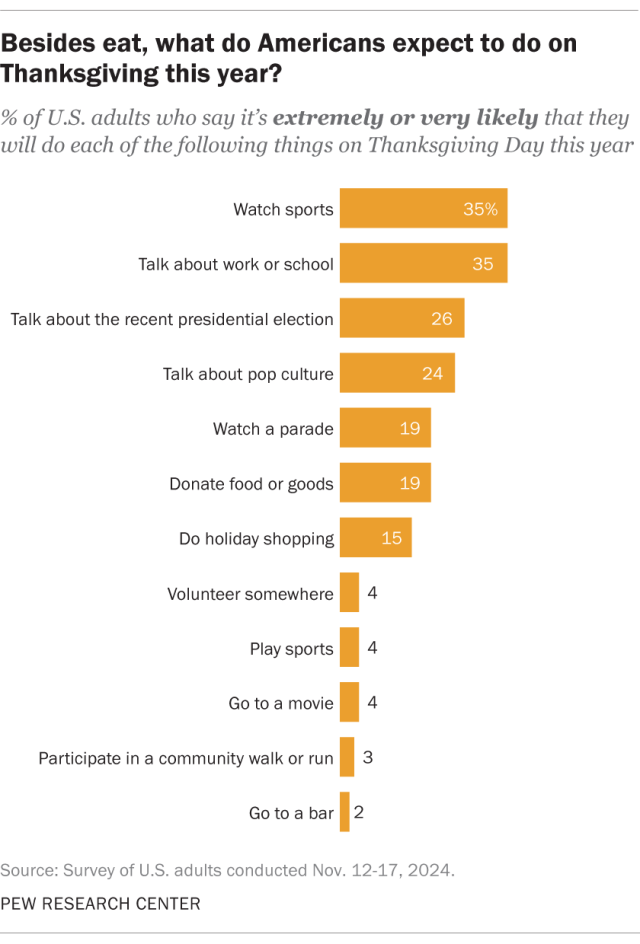
A bar chart showing what Americans expect to do on Thanksgiving this year.

When it comes to conversation, 35% of Americans say it’s extremely or very likely that they’ll talk about work or school on Thanksgiving. And in the wake of a presidential election that saw more than 154 million Americans cast ballots, 26% expect the election to come up. A similar share (24%) expect to talk about pop culture like music or movies, though far fewer (4%) expect to go to a movie.

Thanksgiving is a time for charity for many Americans, and 19% say it’s extremely or very likely that they’ll donate food or goods, while 4% expect to volunteer somewhere.

Thanksgiving is also the unofficial start of the holiday shopping season. Accordingly, 15% of Americans say it’s extremely or very likely that they’ll shop for the holidays on Thanksgiving Day this year.

Getting some exercise on Thanksgiving is a less popular idea: Only 4% of adults say it’s extremely or very likely that they’ll play sports, while 3% expect to participate in a community walk or run, like a turkey trot.

Following Donald Trump’s reelection on Nov. 5, Trump voters are more likely than Kamala Harris voters to say they’ll talk about the presidential election this Thanksgiving. Some 36% of Americans who voted for Trump say it’s extremely or very likely that they’ll talk about the election on Thanksgiving. A smaller share of Americans who voted for Harris (24%) say the same.
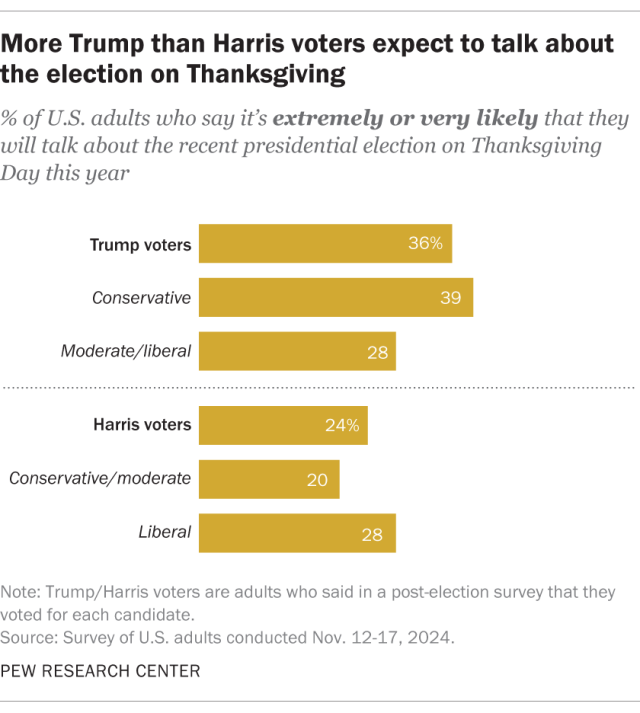
A bar chart showing that more Trump than Harris voters expect to talk about the election on Thanksgiving.

Trump voters who identify as conservative are the most likely to talk about the election: 39% say it’s extremely or very likely that they’ll do so on Thanksgiving, compared with 28% of Trump voters who identify as moderate or liberal. Among Harris voters, 28% of self-described liberals expect to talk about the election at Thanksgiving, compared with 20% of those who identify as conservative or moderate.

In fact, conservative Trump voters are about as likely to talk about the election this Thanksgiving as they are to talk about work or school (36%) – and much more likely to talk about it than to talk about pop culture (17%). By comparison, liberal Harris voters are more likely to talk about work or school (42%) and pop culture (38%) than the election.

6 Rules for Arranging Furniture Like a Design Pro

Fix the flow of your space By Lisa Milbrand  Published on October 20, 2024Orange sofa in cozy living room interior with pastel green wall and wood furniture. Wall mockup

PHOTO: VASYL CHEIPESH/GETTY IMAGES

Sometimes, the hardest part of designing and decorating the spaces in your house is figuring out what to put where. And arranging furniture to suit your space can feel a little bit like a very expensive game of Tetris, where you’re looking for just the right way to situate everything to make it look—and feel—like home.

Fortunately, the design pros have a set of rules—everything from how close you should situate your furniture to how big your rug should be—to ensure the rooms in your home look and feel as beautiful and comfortable as possible. So do a little shuffling and rearranging following these rules, and get the stylish space you seek.

Think About How You’ll Use the Space

Gallery of trendy posters in elegant grey living room interior with brown corner sofa
KATARZYNA BIALASIEWICZ/GETTY IMAGES

You’ll want to make your design choices based on how you’ll actually use the space. For example, if you tend to eat in your living room, choose lower side tables around your living room seating to make it easier to drop your drinks and snacks there. And if you want to put your feet up at the end of the day, you’ll want to sneak a stool or coffee table a bit closer to your sofa. Leave Enough Room for People to Move

Side view of a blue bedroom interior with a modern lamp, double bed, plants and cabinet
KATARZYNA BIALASIEWICZ/GETTY IMAGES

People shouldn’t have to shimmy past the furniture in your home, so make sure that you leave clear pathways around your furniture.

The amount of space you should leave, however, varies. For high traffic areas, Rosanna Bassford of Memmo Interiors likes to leave three to four feet of space, but a smaller space—like two to three feet, in between furniture and in lower traffic areas. “For example, if your sofa backs up to a major walkway from one room to another, be sure to leave plenty of space,” she says. “I like to plan at least three feet of space around a dining table for the dining chairs to be comfortably pulled out.”

In bedrooms, Helft recommends four feet of clearance around the bed, if possible, to allow for easy movement.

Hang Artwork Lower Than You Think

living room with gray couch, wall of artwork, wooden coffee table, lamp and wooden chair

An across-the-board concern for designers: most people are placing their artwork way too high on their walls. Goldberg advocates for placing it at gallery height, about 57 inches high, while Helft varies art placement. “Artwork is supposed to be eye level, which is usually around 55 inches from the floor,” she says. “Over sofas, it needs to go slightly lower—you need to be able to see it while you’re sitting on the sofa. The bottom of the artwork should be 10 inches above the top of the seat back.”

Break a Large Room Into Smaller Spaces

Living room separate space
MALKA HELFT

You don’t want to spread out your furniture too much. So if you’re lucky enough to have a larger open living area, use rugs and furnishings to help break that into smaller spaces. Helft likes to create a separate game space with a small table and a pair of chairs that’s outside of the main conversation area—but you could also transform a cozy corner into a reading nook, crafting space, or a little office.

Size the Rug Right

Living room with large area rug
HERO IMAGES/GETTY IMAGES

When you’re choosing area rugs, make sure that you choose one large enough to fit the space appropriately. That means that for a conversation area in the living room, all of the seating and tables should at least have the front two legs on the rug. In a dining area, you want to ensure that everyone can slide their chairs out and still have all of the legs completely on the rug—you don’t want someone accidentally tipping a chair if your rug is too plush and their chair legs end up off the rug.

Remember That Rules Are Made to Be Broken

Living Room
OSCAR WONG/GETTY IMAGES

Yes, it’s a little bit of a cheat, but even the most common interior design rules around furniture arranging are made to be broken, depending on the unique aspects of your own space and how you plan to use it.

“It’s okay to break the rules on occasion to give a space a custom feel and represent the homeowner,” Goldberg says. “It’s dependent on the space and the heights of our clients, as we want everything to function best for those who live there. And if there is a piece you love, find a way to make it work in the space.”

The 20-Minute Cleaning Routine You Should Do Every Night

According to a Professional Organizer, Wake up to a serene space each morning by performing this short “closing shift” ritual.

By Mary Cornetta
white farmhouse kitchen with shiplap walls and black granite countertops
PHOTO: BRIE WILLIAMS

Even if you’ve never worked in retail or a restaurant, you’ve likely heard of the term ‘closing shift.’ This refers to the end-of-day cleaning routine that typically takes place in a business, but it can be applied to your residential space too. Recently, content creators in the lifestyle space have taken to social media to share their opening and closing shift routines. Essentially, this involves either starting your day by tidying your home, or spending a few minutes before bed getting your house in order. As a professional organizer, I recommend the latter, because it’s all too easy to skip the early routine on busy mornings.

Rather than spend an entire Sunday resetting your home, a 20-minute routine every night is an effortless way to keep your space clean and clutter-free all week long. So, before you hit the hay, set a timer and tackle the following tasks so you can start the next day on the right foot.

1. Clear the Sink (5-7 Minutes)

The kitchen sink is among the dirtiest spots in a home because they harbor bacteria and moisture, especially throughout the day. After dinner, either load and run the dishwasher or handwash dishes and add them to the drying rack. If you have a garbage disposal, use it to remove any lingering debris. Next, thoroughly clean the kitchen sink, including the drain, faucet, and handles. Wipe the entire area dry with a clean cloth. If you feel motivated, do the same with any hand-washed dishes and put them away so you don’t have to do it the next day.


2. Tidy Visible Clutter (5-7 Minutes)

Knocking this off your list will automatically make spaces look neater and lower your stress levels. Talk about a win-win! Take a few minutes to go through high-traffic areas like the living room, entryway, and kitchen and re-home stray items that have piled up throughout the day. Declutter countertops, corral chargers and remote controls, toss kids’ and pets’ toys back into their respective baskets, put back bathroom products, and place shoes onto racks. Depending on each day’s level of clutter, this part of the closing shift may take a little longer, but it’s worth the effort once it’s done.

3. Wipe Down Surfaces (1-2 Minutes)

Now that you have a clean slate to work with, give commonly used surfaces a quick wipe down. Clean kitchen countertops (including the island) and the stovetop by first removing crumbs and then spraying an all-purpose cleaner. If you ate at the kitchen, dining room, or even the coffee table, don’t forget to wipe those as well. Bathroom counters are quick to collect stains from makeup, skincare, and toothpaste. So, since you cleared products in the previous step, you can easily scrub your vanity before bedtime. Have a few more seconds to spare? Clean splatters on the mirror while they’re fresh rather than wait to scrub them on the weekend.

4. Make the Couch (1-2 Minutes)

Just like making the bed each morning is a good habit, it’s just as important to make the couch in the evening. Even if you only spent an hour or two enjoying your favorite show, chances are the sofa could use some straightening up. Most nights, you can get away with simply fluffing the cushions and throw pillows and refolding and putting the blankets back where they belong. If you notice crumbs or excessive pet hair, remove them with a handheld vacuum cleaner or lint roller. Any food that’s fallen between the cushions can encourage pests, so it’s not something you should wait to address. This part of the closing shift sets up the sofa so you can relax without worrying after a long day tomorrow.

5. Empty the Trash (1-2 Minutes)

You most likely do this on a nightly basis already, but you can tack it on at the end of your closing shift to signal that the day is officially over. First, collect any small bags that are full (such as those from bathroom wastebaskets) and add them to the kitchen trash. Take that bag and any recycling you may have to the curb or into their respective outdoor cans on the nights you don’t have a pickup. Clean trash can spills or stains right away so odors don’t linger. Finish by replacing any empty cans with new bags.

Optional Add-On Tasks

If you have an extra few minutes or a bit of extra energy before bed, try tacking the following tasks onto your closing shift for a smoother morning routine.

  • Sweep the floors or, better yet, run the robot vacuum after cleaning surfaces and while finishing up your closing shift.
  • Tidy up the bedroom by putting away clothes and accessories, including laundry that was folded and abandoned earlier in the day on the dreaded clothes chair.
  • Prep for tomorrow by setting the coffee maker, laying out your outfit, and packing lunches and bags.

8 Front Door Decor Ideas That Will Instantly Boost Your Home’s Curb Appeal

Visitors will have a great first impression. By Amanda Lauren

Colourful stained glass wooden door of a traditional Victorian house
PHOTO: ALENA KRAVCHENKO/GETTY IMAGES

A home’s curb appeal is so important. After all, you never get a second chance to make a first impression. So if you’re trying to make your home look more stylish and welcoming, it’s always a good idea to start at the front door. While you might think there isn’t much you can do with this simple area, you’ll be surprised at all the ways you can elevate this space. Even just one or two of these front door decor ideas might make you feel as if you are entering a different home entirely.

  • Amy Switzer is an interior designer and the founder of Amy Switzer Design
  • Sierra Fox is an interior designer at Studio Mountain

Swap Out Your Current Front Door

stained glass front door

Is your door looking a little old? Or is it a little boring? Why not replace the door itself? Whether you want something traditional with windows or stained glass, or a modern aesthetic with reclaimed wood, don’t miss this opportunity to change the look of your home’s exterior. You don’t even have to get something new, there are vintage doors that can give this spot a new life. 

Paint the Door

blue painted front door

If you want to keep your old door and elevate it inexpensively—get out your can and brush. A new coat of paint not only adds curb appeal, but the options are endless. “When painting a front door, you can go bold or stay classic, depending on your home’s vibe,” says interior designer Amy Switzer.

Not sure what front door color to go with? “Deep navy, matte black, or even a rich jewel tone like emerald green can add sophistication,” she explains. “For a more playful look, consider something like coral or soft turquoise.”

Swap Out Your Hardware

front door knocker

Sure, your current doorknob opens the door, but it might not be doing much more than that, according to interior designer Sierra Fox. “If you’re looking to add an interesting and artistic moment to your front entry, adding a vintage door knocker or doorbell plate is a simple yet impactful way to enhance this space,” she says. “Look for a design that resonates with your style, and opt for a living finish to allow the piece to develop a timeworn beauty with age.”

On the other hand, if you have a more modern home or prefer hardware you can easily order online, Switzer suggests going with matte black or antique brass, which can be found at most hardware retailers. “These are really on-trend right now and contrast beautifully with bright or dark door colors.”

Add Some Plants

front door potted plants

Want to add some charm? Consider layering container plants at different heights. “Think about oversized statement planters in ceramic or concrete, and fill them with seasonal blooms or greenery like ferns or grasses. A few small topiaries or succulents in unique pots would work, too,” Switzer says.

If you have trouble keeping plants alive (we’re not judging), that doesn’t mean you can’t achieve this look. You just need to be creative. “As someone who always has dead plants, faux plants are a great option for planters outside as well,” she explains.

Hang a Wreath

front door sunflower wreath

Wreaths aren’t just for the holidays, they’re a gorgeous way to welcome guests to your home all year round. There are so many types of wreathsout there—from flowers to olive branches, and even beautifully scented ones made from eucalyptus. If you live in a location with inclement weather, consider going with an artificial wreath because it’s a more durable choice.

Welcome Guests with a Doormat

front door welcome mat

Doormats are highly underrated. Whether you get a statement doormator perhaps a practical yet stylish one to remind guests and family members to wipe their feet—these accessories can add both color and texture. Not sure what style you want? A simple monogram doormat is a timeless choice you likely won’t regret.

Brighten Up the Way with Sconces

front door sconce

Having good lighting at your front door isn’t just about being able to see when you fumble for your keys—adding a fixture or two can level up the space in a new way. Consider adding sconces to each side of the door or one bold one depending on the space. You can even choose one with a sensor so the bulb turns on automatically as you approach the door.

Create a Seating Area

front door seating area

If you have a little bit of extra space, consider adding a seating area to your front door. Go with a bench or perhaps even an old-fashioned porch swing. Even if you only have room for just one chair—go for it. A bold seat can be fun and sophisticated. Don’t forget to accessorize with a pillow and cushion.

Contact UsWork With a Local Expert

Whether you are buying or selling, your real estate needs are unique to you. As your local real estate expert we are here to be your guide. Contact us today - we're here to help.

Contact Us

Footer

Rising Star Real EstateFlorida Real Estate Experts

(850) 613-6832|Contact Us|1191 Eglin Parkway, Suite G, Shalimar, FL 32579
company logo

DRE#   •   sitemap   •   admin   •   ©2026 All Rights Reserved  •  Real Estate Website Design opens in new window by IDXCentral.com